English
 日本語
日本語
 Deutsch
 Español
No.158, Baoqun Road, Yaozhuang Town, Jiashan County, Jiaxing City, Zhejiang Province , China
News
Home / News / Industry News / What Is a Vibration Conveying Mechanical Structure and How Does It Improve Material Handling Efficiency?

Content
In modern industrial environments, moving bulk materials smoothly, quickly, and reliably is a persistent challenge. Among the many solutions available, the vibration conveying mechanical structure stands out as a highly efficient method for transporting granular, powdery, or even lumpy materials across production lines. Unlike traditional belt or screw conveyors, this system uses controlled oscillations to propel materials forward, offering unique advantages in terms of cleanliness, energy use, and process integration.
A vibration conveying mechanical structure is an assembly of interconnected components designed to transfer vibratory motion to a trough or tube, causing bulk materials to move along a desired path. The core principle is micro-throw: each vibration cycle lifts the material slightly off the conveying surface and throws it forward a small distance. Repetition of this cycle at high frequency creates continuous forward movement.
The main elements of such a structure include:
Unlike rotary or linear feeders that push material directly, this structure relies on inertia and controlled acceleration. That makes it exceptionally gentle on friable products and ideal for high-temperature or abrasive materials.
| Component | Function | Typical Material |
|---|---|---|
| Drive unit | Generates vibratory force | Cast iron / steel |
| Spring system | Stores and releases energy | Spring steel |
| Conveying trough | Guides material flow | Stainless steel / abrasion-resistant plate |
| Base frame | Provides structural stability | Welded structural steel |
| Damping elements | Isolates vibration | Rubber / polyurethane |
Efficiency in material handling is not just about speed—it involves throughput, energy consumption, maintenance frequency, product integrity, and system integration. The vibration conveying mechanical structure addresses all these dimensions.
The oscillatory action produces a steady, uniform layer of material without surging or segregation. By adjusting vibration amplitude and frequency, operators can fine-tune the conveying speed instantly, even while the system is running. This enables precise feeding into crushers, screens, or packaging machines.
Because the system relies on resonance—springs store and release energy each cycle—only the damping and material load require new energy input. Compared to belt conveyors needing constant motor torque to overcome friction, vibrating conveyors often consume 30–50% less energy for equivalent throughput.
With no rotating shafts, bearings inside the material zone, or sliding seals, wear points are minimal. The conveying trough does not contact moving parts except through vibration. This eliminates belt tracking issues, pulley alignment, and roller jamming. Maintenance typically involves checking spring bolts and drive unit bushings—tasks that can be scheduled during brief production pauses.
Vibrating conveyors can be fully enclosed with dust-tight covers. The absence of belts or chains means no carryback or spillage at transfer points. This improves workplace safety, reduces product loss, and simplifies compliance with environmental regulations.
Materials that are hot, abrasive, sticky, or fragile often challenge conventional conveyors. A vibration conveying mechanical structure handles:
To achieve high material handling efficiency, the vibration conveying mechanical structure must be properly designed for the specific application. Critical parameters include:
Poor design leads to sluggish movement, excessive noise, or structural fatigue. That is why specialized manufacturers focus on custom engineering rather than one-size-fits-all products.
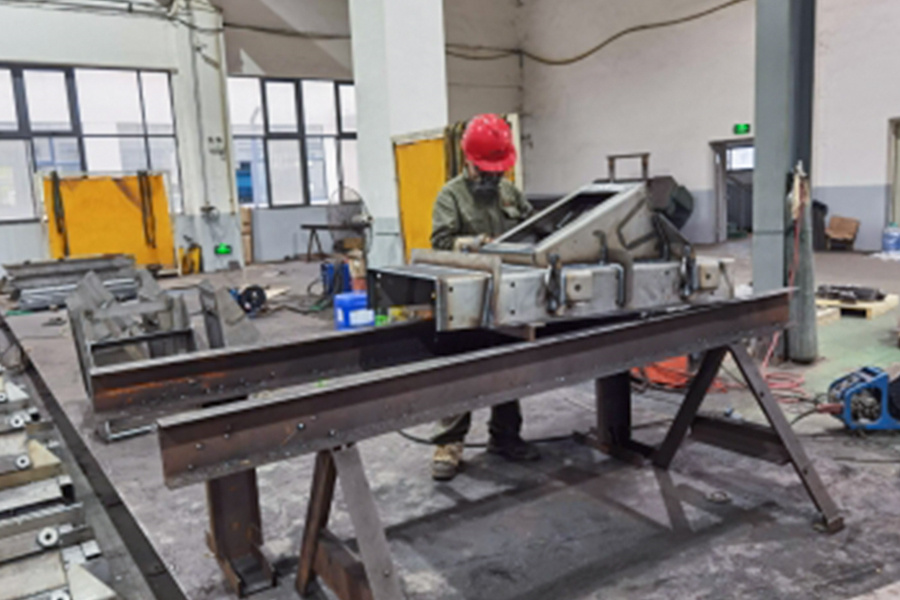
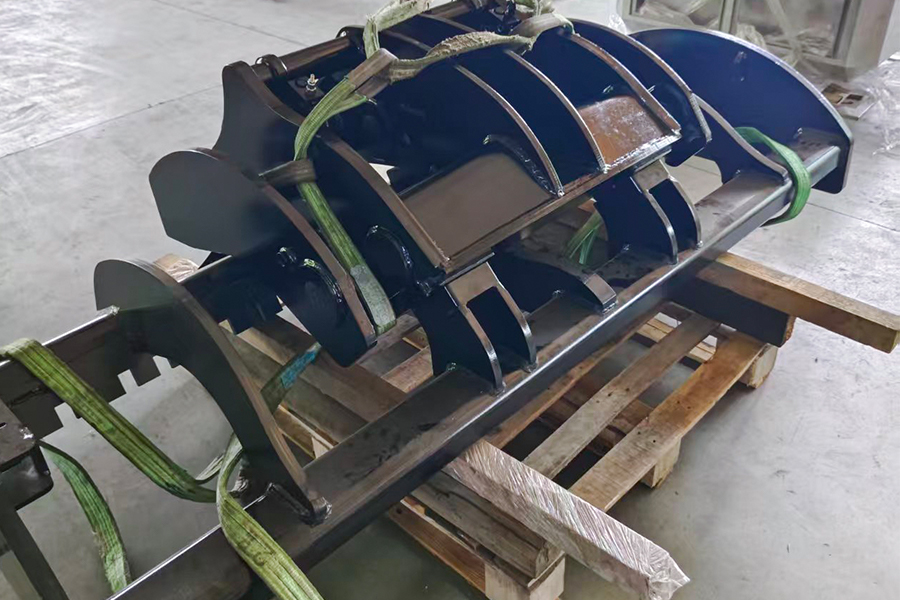
High-quality fabrication of these structures requires precision welding, stress-relieving, and surface protection, especially for components subject to continuous cyclic loading.
For instance, Jiaxing Dingshi Machinery Manufacturing Co., Ltd. has been a leading manufacturer of custom welded structural steel parts since 2014. Possessing certifications including EN1090, ISO3834, ISO9001, ISO14001 and ISO45001, the company provides one-stop services encompassing cutting, bending, curling, leveling, welding, machining, shot blasting, sandblasting, spraying, painting, and assembly. Their vibrating conveyor machinery construction services focus on providing a variety of key components for vibrating conveyors, including vibrating screens, vibrating feeders and vibrating conveyor belts. With many years of experience in cooperating with German companies, they ensure high quality and performance of each component. Their technical team is familiar with the working principles and application scenarios of various vibration conveying equipment, and can provide the best structural design and manufacturing solutions using high-strength materials and advanced processing techniques to ensure long product life and low maintenance requirements, helping customers improve production efficiency and reduce operating costs.
| Industry | Material Type | Efficiency Gain |
|---|---|---|
| Food processing | Frozen vegetables, nuts, cereals | Gentle handling, easy cleaning |
| Foundry | Sand, castings, shot blast media | Heat resistance, low wear |
| Recycling | Shredded metal, plastic flakes | Enclosed operation, variable speed |
| Mining | Ore, aggregates | High capacity, low energy |
| Chemical | Powders, granules | Dust-tight, corrosion-resistant options |
Q1: Can a vibrating conveyor handle wet or sticky materials?
Yes, but the trough may need a special liner (e.g., UHMW or stainless steel with low friction) and higher amplitude. For extremely sticky materials, a heated trough or impact bars can prevent buildup.
Q2: Is noise a problem with vibrating conveyors?
Modern designs with rubber-isolated drives and tuned springs operate at 75–85 dB(A)—comparable to a belt conveyor. Excessive noise usually indicates loose parts or incorrect frequency tuning.
Q3: How long does a typical vibration conveying structure last?
With proper design and maintenance, service life exceeds 15 years. Wear is concentrated on the trough liner (replaceable) and spring sets (every 5–8 years). The structural frame—especially when fabricated to EN1090 or ISO3834 standards—can last decades.
Q4: Can I retrofit a vibrating conveyor into an existing line?
Yes. These structures are modular and can be floor-mounted, suspended, or integrated with hoppers. However, ensure the foundation can handle dynamic loads—isolators are often required.
Q5: What maintenance does it require weekly?
The vibration conveying mechanical structure is not a niche or outdated technology—it is a mature, highly efficient solution for moving bulk solids in demanding environments. By leveraging controlled oscillation, resonance energy recovery, and minimal contact surfaces, it improves material handling efficiency through lower energy use, reduced downtime, cleaner operation, and superior material preservation. For operations dealing with abrasive, hot, fragile, or dusty products, investing in a properly engineered vibrating conveyor can yield rapid payback through reduced waste and maintenance.
Why Steel Structure Frame Welding Fails: A Practical Diagnosis Guide Steel structure...
READ MORE
Storage racks carry heavy loads day after day, often for decades. The welds that ho...
READ MORE
Understanding Heavy-Duty Steel Structure Welding Large-scale construction and indust...
READ MORE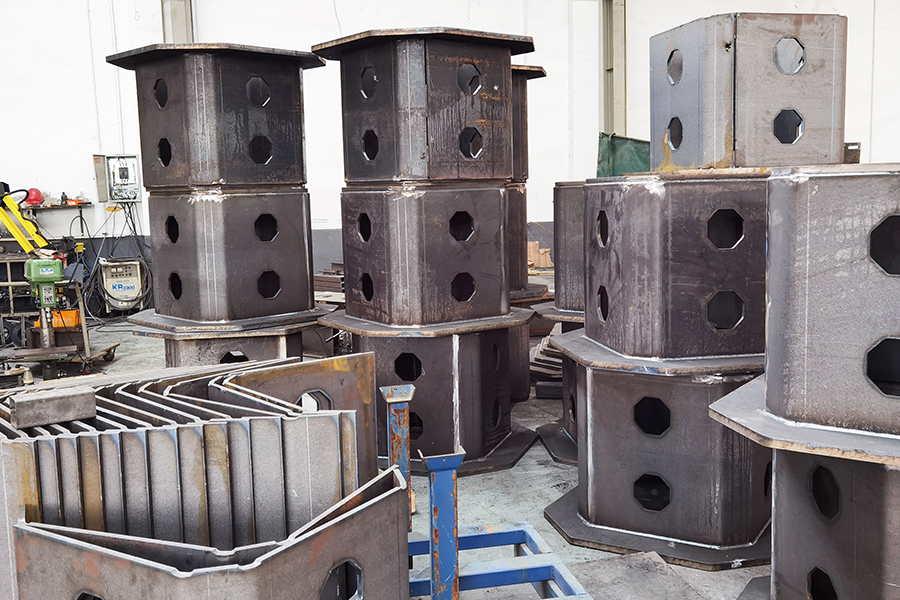
Why Equipment Structural Framework Welding Demands More Than Just a Welder Not all w...
READ MORE
No.158, Baoqun Road, Yaozhuang Town, Jiashan County, Jiaxing City, Zhejiang Province , China
0086 13857303563
+86-573-84893330 / +86-573-84518277
product