English
 日本語
日本語
 Deutsch
 Español
No.158, Baoqun Road, Yaozhuang Town, Jiashan County, Jiaxing City, Zhejiang Province , China
News
Home / News / Industry News / Mastering Distortion Control: How to Minimize Warpage in Large-Scale Steel Weldments

Content
In the realm of heavy fabrication, controlling distortion remains one of the most persistent challenges. Large-scale steel weldments, by their very nature, are susceptible to warpage due to non-uniform thermal expansion and contraction during the welding process.
Distortion occurs when localized heating from welding induces plastic strain in the base material. As the molten pool solidifies, shrinkage forces act unevenly across the joint. In large-scale weldments—such as beams, columns, and frames—the cumulative effect of multiple passes and long weld seams amplifies this behavior. Key factors include:
Without proactive control, warpage leads to costly rework, alignment issues, and compromised fatigue performance.
Effective distortion control rests on three pillars: heat management, restraint optimization, and sequence planning. Below is a summary of countermeasures categorized by their mechanism.
| Control Strategy | Mechanism | Typical Effect |
|---|---|---|
| Presetting (pre-bending) | Offsets expected angular change | Reduces final out-of-flatness |
| Balanced welding | Alternating sides of neutral axis | Minimizes bending distortion |
| Back-step technique | Reverse deposition direction per pass | Lowers longitudinal shrinkage |
| Heat sinking | Localized cooling of adjacent zones | Reduces residual stress gradient |
| Interpass cooling | Controlled delay between passes | Limits peak temperature |
These methods are most effective when applied systematically rather than as isolated corrections.
Before any arc is struck, the following steps substantially reduce distortion risk.
Butt joints with narrow grooves (e.g., U or J preparations) reduce weld volume compared to single-V or double-V designs. Less deposited metal means less shrinkage force. For fillet welds, specifying the smallest acceptable leg size—rather than over-welding—directly lowers heat input.
High-strength fixtures prevent movement during welding, but excessive restraint can increase residual stress. A balanced approach uses strongback bars or temporary stiffeners placed on the non-welding side. These are removed after cooling, allowing gradual stress relaxation.
For large weldments with neutral axis shift—such as a web-to-flange joint—a small opposing bend (preset) can be applied before welding. When the weld shrinks, the part springs back to flat. Typical preset angles range from 0.5° to 2° depending on plate thickness and weld size.
During actual welding, real-time decisions dictate success or failure. The following practices are universally applicable.
Active cooling (water or compressed air) is generally discouraged for structural steels because it risks hydrogen cracking and hardened microstructures. Instead, use:
When welding a large stiffened plate, start from the center and move outward symmetrically. For box columns, weld the four longitudinal seams in a rotating order—first pass on seam 1, then seam 3, then 2, then 4. This prevents cumulative angular distortion.
Light mechanical peening (using a blunt tool) along the weld toe after each pass relieves residual stress through local plastic deformation. Vibratory stress relief during welding, applied through the fixture, can also reduce distortion by promoting uniform grain relaxation. However, these are supplementary, not primary, measures.
Even with meticulous planning, minor warpage may persist. The table below compares common rectification methods.
| Method | Applicability | Risk | Cost |
|---|---|---|---|
| Line heating (spot heating) | Local angular distortion | Overheating, buckling | Medium |
| Mechanical pressing | Large flat panels | Spring-back | Low |
| Flame straightening with cooling | Heavy sections | Hardening | High (skilled operator) |
| Thermal-vibration combination | Complex weldments | Cracking if uncontrolled | Medium |
Flame straightening must follow strict temperature limits (600–650°C for structural steel) and avoid repeated heating of the same zone.
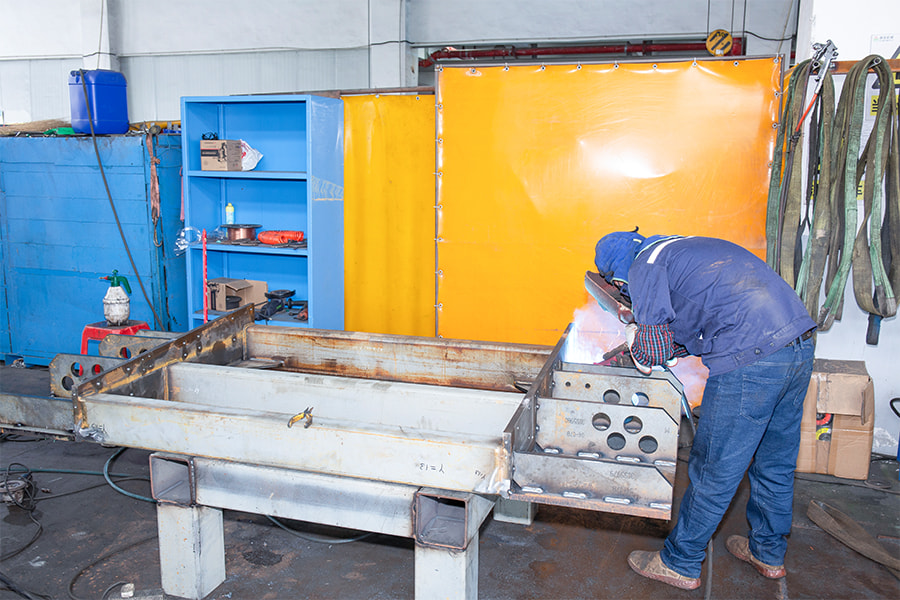
Consider the environment of a rack welding factory, where long vertical columns and horizontal beams must maintain straightness within 1.5 mm per 3 m. High-volume production demands both speed and precision. Here, distortion control is achieved through:
Jiaxing Dingshi Machinery Manufacturing Co., Ltd. specializes in custom welded structural steel parts, holding EN1090, ISO3834, ISO9001, ISO14001, and ISO45001 certifications. Its one-stop services cover cutting, bending, curling, leveling, welding, machining, shot blasting, sandblasting, spraying, painting, and assembly.
Welding is a core process in equipment steel structure manufacturing. Advanced welding technology and equipment ensure each joint meets the highest strength and quality standards. Certified welders master arc welding (SMAW), argon-arc welding (TIG), gas welding, and laser welding, adapting to diverse steel structures and working environments. Every welding process strictly follows international standards and customer technical requirements. Through precise process control and continuous quality monitoring, each weld remains defect-free and highly reliable.
This systematic approach results in durable, robust steel structures that resist warpage even under high-load racking applications.
Even experienced fabricators encounter distortion when ignoring basic rules. The most frequent errors include:
A simple checklist before each critical weldment can prevent these mistakes: verify fit-up, measure starting temperature, confirm sequence plan, and inspect fixture rigidity.
Large-scale steel weldments vary widely. The following recommendations address common geometries.
Long beams (I-section, H-section):
Large flat plates with longitudinal stiffeners:
Box columns and tubular sections:
Every millimeter of warpage that requires flame straightening or press correction adds labor hours, material handling, and potential weakening of the structure. A well-controlled welding procedure reduces post-weld straightening by over 70%, directly lowering production costs. Moreover, dimensional accuracy improves assembly fit-up, eliminating re-drilling, reaming, or shimming in the field.
From a quality assurance perspective, controlling distortion also enhances fatigue life. Parts straightened by plastic deformation contain residual stress concentrations that may become crack initiation sites under cyclic loading. Therefore, prevention is not only cheaper but also structurally superior.
Minimizing warpage in large-scale steel weldments is a systematic engineering task—not a matter of luck or brute force. By understanding thermal shrinkage, applying pre-weld planning, executing symmetrical sequences, and using post-weld correction only as a last resort, fabricators can achieve sub-millimeter accuracy. Whether in a specialized rack welding factory or general heavy fabrication shop, these principles remain universal.
Why Steel Structure Frame Welding Fails: A Practical Diagnosis Guide Steel structure...
READ MORE
Storage racks carry heavy loads day after day, often for decades. The welds that ho...
READ MORE
Understanding Heavy-Duty Steel Structure Welding Large-scale construction and indust...
READ MORE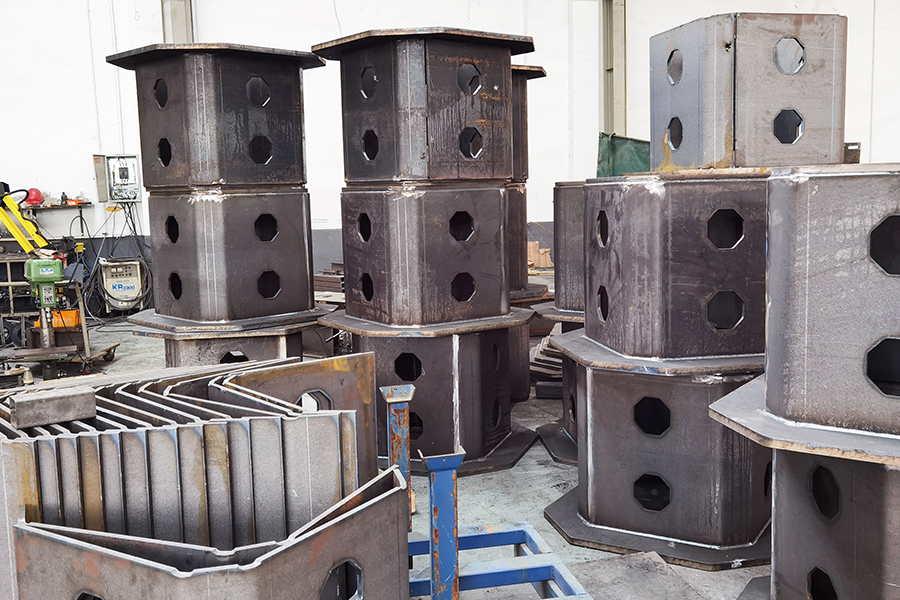
Why Equipment Structural Framework Welding Demands More Than Just a Welder Not all w...
READ MORE
No.158, Baoqun Road, Yaozhuang Town, Jiashan County, Jiaxing City, Zhejiang Province , China
0086 13857303563
+86-573-84893330 / +86-573-84518277
product