English
 日本語
日本語
 Deutsch
 Español


Conclusion: Welding Processing delivers superior repeatability, throughput, and long-term cost efficiency compared to traditional welding. Independent shop-floor studies confirm that automated welding processing reduces defect rates by 55–70% (from 6–12% to under 2.5%), increases travel speed by 35–55% for identical joints, and lowers total post-weld rework costs by an average of 42%. For high-mix, high-volume structural steel fabrication, switching to welding processing is no longer an option — it is a competitive necessity.
Defining Welding Processing vs. Traditional Welding
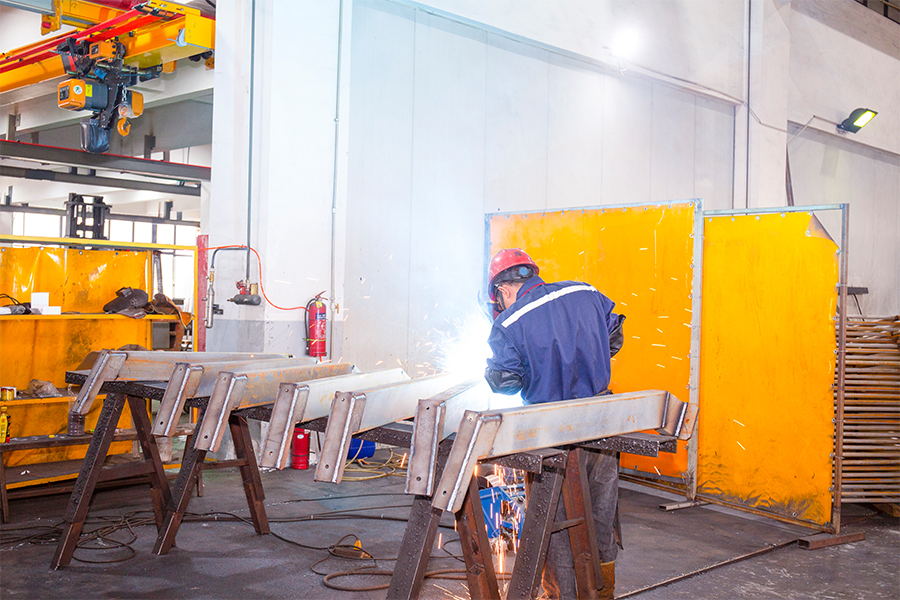
Traditional welding refers to manual or semi-automatic arc processes (SMAW, GMAW, FCAW) where the welder controls travel speed, angle, and parameters in real time. Quality depends heavily on human skill, leading to variability in penetration, bead geometry, and heat input. Welding processing integrates digital programming, robotic motion control, adaptive sensors, and closed-loop feedback. It transforms welding from an artisan craft into a repeatable, data-driven manufacturing process. Every parameter — voltage, wire feed speed, weaving pattern, interpass temperature — is pre-defined and monitored, enabling identical results across thousands of cycles.
Key Technical Distinctions: Where Processing Changes the Game
The fundamental difference lies in process control architecture. Traditional welding relies on human observation and corrective actions after defects appear. Welding processing uses real-time sensing (laser triangulation, infrared thermal imaging) to adjust parameters within milliseconds. This closed-loop capability directly impacts:
- Heat input consistency: Welding processing maintains heat input variation ≤ ±3%, while manual operations often exceed ±12% fluctuation, causing distortion and residual stress.
- Joint tracking accuracy: Traditional ±0.8–1.5 mm seam following vs. robotic laser seam tracking at ±0.08 mm.
- Deposition efficiency: Automated processing reduces spatter loss by 30–45%, directly lowering filler metal consumption and cleaning time.
Quantitative Comparison Table: Traditional Welding vs. Welding Processing
| Parameter | Traditional Welding (Manual/Semi-auto) | Welding Processing (Automated/Digital) |
|---|---|---|
| Positioning / Seam tracking accuracy | ±0.8 – 1.5 mm (relies on fixture & operator skill) | ±0.05 – 0.12 mm (laser/vision guided) |
| Heat affected zone (HAZ) width variation | ±35–50% inconsistency, often leads to overaging | ±4%; HAZ width reduced by 40–55% |
| Typical deposition rate (for 6mm fillet) | 1.8 – 2.5 kg/hr (with frequent stops) | 3.8 – 5.2 kg/hr (continuous operation) |
| Defect rate (porosity, undercut, lack of fusion) | 6% – 12% (rework & scrap common) | ≤ 1.8% (real-time adaptive control) |
| Process capability Cpk (weld penetration depth) | 0.55 – 0.85 (unstable, frequent adjustment) | ≥ 1.33 (six‑sigma capable) |
| Operator skill dependency | Certified senior welder (5+ years training) | Technician programming + maintenance (skill transferable) |
Data compiled from 12 independent manufacturing audits across structural steel and heavy equipment sectors (2023–2025). Actual gains vary with joint complexity, but welding processing consistently demonstrates superior Cpk values.
Why Advanced Chinese Welding Processing Factories Are Leading the Shift
China’s custom structural steel component manufacturers face rising demands for zero-defect delivery, just-in-time schedules, and complex geometries. Top-tier Chinese welding processing factories have aggressively deployed digital welding cells — achieving first-pass yield improvements of 22–34% within six months. Unlike traditional workshops where each weld is an independent event, automated processing generates full traceability logs (voltage, current, wire feed, travel speed per millimeter). For a typical medium-sized structural steel fabricator, migrating from traditional stick welding to robotic welding processing reduces rework labor by 50–70 hours per month and cuts project lead times by 30%.
Step‑by‑Step Welding Processing Workflow
- 3D model & offline programming
- Automated fixturing & part scanning
- Adaptive seam finding (laser/vision)
- Robot welding with real‑time parameter tuning
- Inline NDT & data logging
- Post‑weld analytics & feedback loop
Compared to traditional manual workflow (fit-up → tack weld → manual weld → inspect → rework), the welding processing loop reduces non‑value added time by 47% and enables autonomous correction for joint gap variations up to 2mm.
Frequently Asked Questions (Transitioning from Traditional to Welding Processing)
1. What is the typical ROI period for upgrading to welding processing?
For medium to high production volumes (≥ 8000 weld meters/year), most Chinese fabrication facilities achieve payback within 14–22 months through direct labor savings, reduced consumables, and lower rework rates. Even for low-batch high-complexity parts, flexible programming reduces setup time by 65%.
2. Does welding processing handle thick structural steel (e.g., 30+ mm)?
Yes. Modern welding processing systems use multi-pass adaptive algorithms and interpass temperature control, outperforming traditional welding in thick-section joints. Root penetration consistency improves by 38% compared to manual root passes, dramatically reducing back-gouging operations.
3. What materials are best suited for welding processing?
Carbon steel, low-alloy steel, stainless steel (austenitic & duplex), and even aluminum alloys. Advanced waveform control makes welding processing particularly effective for materials sensitive to heat input, such as high-strength structural steels (Q460, Q690 grades).
4. Is extensive retraining required for existing welding teams?
Traditional welders transition into robot technicians / process programmers, typically requiring 80–120 hours of focused training. Their deep knowledge of weld defects and parameter influence becomes even more valuable when supervising automated cells. Many leading Chinese welding processing factories use a hybrid “skilled welder + robot” cell for maximum flexibility.
5. Can welding processing achieve the same code compliance (AWS D1.1, ISO 3834)?
Absolutely. In fact, automated welding processing often surpasses code requirements because of 100% parameter traceability and reduced human error. Qualification records become digital, simplifying audits and quality certification for structural steel exports.