English
 日本語
日本語
 Deutsch
 Español
No.158, Baoqun Road, Yaozhuang Town, Jiashan County, Jiaxing City, Zhejiang Province , China
News
Home / News / Industry News / What Is Steel Structure Frame Welding and Why Is It Important in Construction?

Content
Steel has long been a cornerstone of modern construction, valued for its strength, versatility, and durability. Among the many processes that enable steel to be used effectively in buildings and infrastructure, steel structure frame welding stands out as one of the most critical. It is the technique that binds individual steel components into a unified structural system capable of withstanding heavy loads, environmental stress, and long-term use.
In today’s construction landscape, where safety standards and performance expectations are continuously rising, understanding the role of welding in steel structures is essential.
Steel structure frame welding refers to the process of joining steel components—such as beams, columns, and plates—using heat and sometimes pressure to create a permanent bond. Unlike mechanical fastening methods like bolting or riveting, welding fuses materials at the molecular level, resulting in a seamless connection.
This process is widely used in the fabrication of structural frameworks for buildings, bridges, industrial facilities, and other large-scale infrastructure. The integrity of these structures heavily depends on the quality and precision of the welding process.
Different welding techniques are applied depending on the project requirements, material properties, and environmental conditions. Below is a comparison of commonly used methods in steel structure frame welding:
| Welding Method | Description | Advantages | Typical Applications |
|---|---|---|---|
| Shielded Metal Arc Welding (SMAW) | Uses a consumable electrode coated in flux | Simple and versatile | On-site construction |
| Gas Metal Arc Welding (GMAW) | Uses a continuous wire feed and shielding gas | High efficiency and speed | Factory fabrication |
| Submerged Arc Welding (SAW) | Arc is submerged under flux | Deep penetration, high quality | Heavy steel sections |
| Flux-Cored Arc Welding (FCAW) | Uses tubular wire filled with flux | Suitable for outdoor work | Structural assembly |
| Gas Tungsten Arc Welding (GTAW) | Uses a non-consumable tungsten electrode | High precision | Thin or critical joints |
Each method has its own role, and selecting the right one is essential for achieving optimal performance and cost efficiency.
The process of steel structure frame welding involves several carefully controlled steps to ensure structural integrity and consistency.
Steel components are cut, cleaned, and shaped according to design specifications. Surface contaminants such as rust, oil, and dust must be removed to ensure proper weld quality.
Components are positioned and aligned accurately before welding. Proper alignment ensures that loads are distributed evenly across the structure.
The chosen welding method is applied under controlled conditions. Parameters such as temperature, current, and travel speed are carefully monitored.
After welding, joints are inspected using visual checks and non-destructive testing methods to detect defects such as cracks or porosity.
Post-weld treatments such as grinding, coating, or painting are applied to enhance appearance and protect against corrosion.
The primary function of steel structure frame welding is to ensure that individual components act as a single, cohesive unit. Welded joints provide continuous load paths, which are essential for maintaining structural stability under dynamic and static loads.
Poor welding can lead to structural failures, which may result in severe safety hazards. High-quality welding ensures that structures can withstand environmental forces such as wind, seismic activity, and temperature variations.
Welding allows for greater design freedom compared to mechanical fastening. Complex geometries and customized structures can be achieved without compromising strength.
Welded joints are less prone to loosening over time compared to bolted connections. This contributes to the long-term durability of the structure, reducing maintenance requirements.
Modern welding techniques improve fabrication speed and reduce labor intensity. This leads to shorter construction timelines and improved project efficiency.
Several factors influence the quality of steel structure frame welding. Understanding these factors is essential for achieving consistent results.
| Factor | Impact on Welding Quality | Control Measures |
|---|---|---|
| Material Quality | Affects weld strength and consistency | Use certified steel materials |
| Welding Parameters | Influences penetration and fusion | Optimize current and voltage |
| Operator Skill | Determines execution accuracy | Ensure proper training |
| Environmental Conditions | Can cause defects like porosity | Control humidity and wind |
| Equipment Condition | Affects process stability | Regular maintenance |
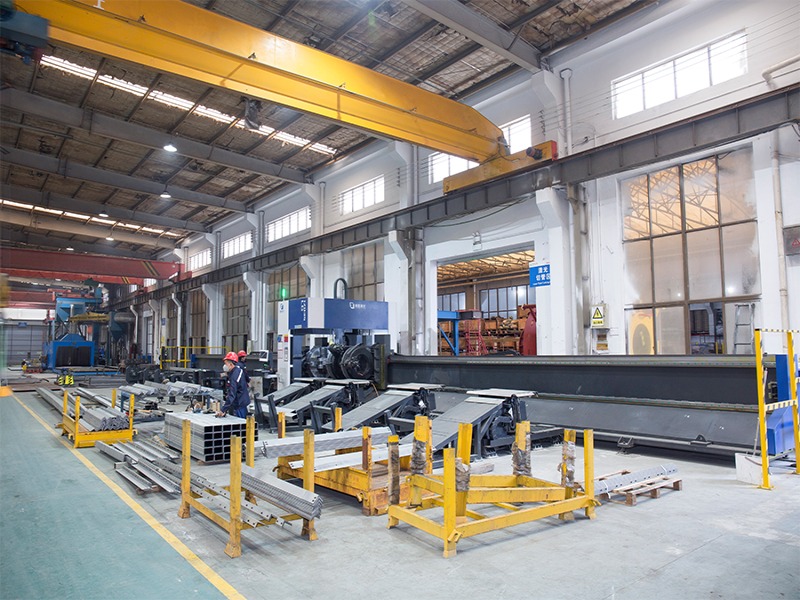
Professional fabrication plays a crucial role in ensuring high-quality welding outcomes. Jiaxing Dingshi Machinery Manufacturing Co., Ltd. has been specializing in custom welded structural steel parts since 2014. With certifications such as EN1090, ISO3834, ISO9001, ISO14001, and ISO45001, the company demonstrates adherence to strict quality and safety standards.
Our one-stop services—including cutting, bending, curling, leveling, welding, machining, shot blasting, sandblasting, spraying, painting, and assembly—highlight the importance of integrated manufacturing processes in achieving reliable steel structures.
When compared to alternative joining techniques, welding offers several distinct advantages:
These advantages make steel structure frame welding the preferred choice in modern construction projects.
Steel structure frame welding is widely used across various sectors:
In each of these applications, the reliability of welded joints directly impacts the overall performance and safety of the structure.
Steel structure frame welding is a fundamental process that underpins the strength, safety, and durability of modern construction. By creating seamless and robust connections between steel components, it ensures that structures can meet the demands of both current and future use.
From material preparation to final inspection, every step in the welding process contributes to the overall performance of the structure.
1. What is the main purpose of steel structure frame welding?
The main purpose is to permanently join steel components, ensuring structural integrity and efficient load transfer within the framework.
2. Which welding method is most commonly used in construction?
Methods like SMAW, GMAW, and SAW are commonly used, with the choice depending on project requirements and working conditions.
3. How does welding improve structural durability?
Welding creates continuous joints that are less prone to loosening or failure, enhancing long-term durability and stability.
4. What factors affect welding quality?
Material quality, welding parameters, operator skill, environmental conditions, and equipment condition all play critical roles.
5. Why is professional fabrication important in welding?
Experienced fabrication ensures precision, compliance with standards, and consistent quality, which are essential for safe and reliable structures.
Why Steel Structure Frame Welding Fails: A Practical Diagnosis Guide Steel structure...
READ MORE
Storage racks carry heavy loads day after day, often for decades. The welds that ho...
READ MORE
Understanding Heavy-Duty Steel Structure Welding Large-scale construction and indust...
READ MORE
Why Equipment Structural Framework Welding Demands More Than Just a Welder Not all w...
READ MORE
No.158, Baoqun Road, Yaozhuang Town, Jiashan County, Jiaxing City, Zhejiang Province , China
0086 13857303563
+86-573-84893330 / +86-573-84518277
product