No.158, Baoqun Road, Yaozhuang Town, Jiashan County, Jiaxing City, Zhejiang Province , China
Content
When construction teams plan a rack project, one of the first decisions is where the welding should happen. A dedicated rack welding factory can often deliver finished assemblies faster and at a more predictable cost than crews working on a live site. The sections below compare both approaches using practical measures such as labor rates, rework exposure, shipping trade-offs, and quality control, so you can decide which route protects your schedule and budget.
For most construction rack and equipment frame projects, shop welding delivers better cost control and schedule certainty than on-site welding. The exceptions are oversized structures that cannot be transported and connections that must be adjusted to field tolerances in real time.
Repeatable parts, standard frame geometries, batch orders, and assemblies that fit on a truck.
Oversized spans that cannot ship, final closure joints, and urgent field repairs.
On-site welding looks inexpensive on paper because it avoids freight charges. In practice, the bill grows quickly once the full picture is counted. Field crews face weather delays, elevated work requires additional fall protection, and welders often spend paid time traveling to the site or waiting for access, lifts, or other trades to finish.
Quality inspection is also harder in the field. Lighting, wind, and limited access restrict how thoroughly joints can be checked, so defects may surface only after the structure is loaded or after finishes have been installed.
| Cost Factor | On-Site Welding | Shop Welding |
|---|---|---|
| Weather exposure | High | None |
| Access and fall protection | Significant | Minimal |
| Inspection coverage | Limited | Near complete before shipping |
| Rework exposure | Costly | Controlled |
On-site welding still has a place. Very large frames that exceed transport limits, final connections that must match as-built conditions, and emergency repairs are typical cases where welding at the job site is the practical choice.
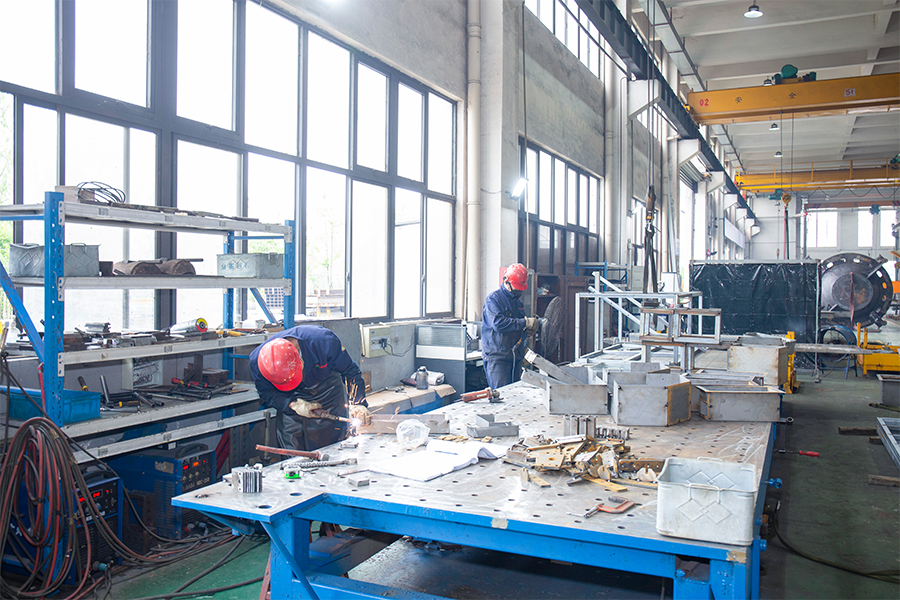
A controlled shop environment lets fabricators use precision fixtures that hold members square and flat throughout the welding sequence. Thin-wall rack components can be kept within tight tolerances, with distortion managed through sequencing, clamping, and controlled heat input rather than corrected after the fact.
Fixtures hold members in position, so frame dimensions repeat from one unit to the next.
Fixed welding stations and automated equipment produce more consistent bead quality than field welding.
Inspection happens at the bench, before the assembly is loaded onto a truck.
Shop labor is not always the cheapest per hour, yet it usually produces far more finished work per hour. A welder in a fabrication bay spends most of the shift arc welding, while a welder on a construction site often loses time to setup, movement, weather stoppages, and waiting for other trades.
Efficiency gains compound when the factory uses dedicated fixtures or a robotic workstation. Repeat parts can be welded in the same sequence every time, which shortens cycle time and reduces the number of welder-hours billed per unit.
Problems found on site are expensive. Fixing a misaligned joint often means cutting out a weld, re-erecting temporary supports, rigging the member again, and sometimes bringing in scaffolding or extra lifting equipment. Each step adds cost and delays downstream trades.
Catching the same issue in the shop is far cheaper. Dimensional checks, visual weld inspection, and where specified non-destructive testing can all be completed before the assembly leaves the factory.
The cheapest weld to fix is the one caught before the part ever leaves the bay.
Shop welding does add freight, and it is fair to count that cost honestly. The useful comparison, however, is between freight and the combined total of field labor premiums, lower productivity, and rework risk. In most projects of normal size, freight is the smaller number.
Freight can be further controlled through smart packing. Nesting components, using stackable frames, and planning truckloads around the delivery sequence all reduce the cost per unit shipped.
Quality is where shop and site approaches diverge most. A rack welding factory can run a full inspection routine on every assembly, while field conditions often limit inspection to what is visible and accessible at that moment.
Traceability is another advantage. Shop records can link welding procedures, filler metal lots, welder identification, and inspection results to each serial-numbered assembly. For load-bearing racks and equipment supports, that documentation supports both client acceptance and long-term maintenance planning.
If your project involves structural racks or equipment supports, request the welding procedure specification and inspection records during the quoting stage rather than after delivery.
Does the factory have experience with construction racks or equipment frames similar to yours?
Does it use dedicated fixtures or robotic workstations for repeat assemblies?
Can it provide dimensional and weld inspection reports with each shipment?
What is the maximum assembly size it can handle, and would any part need to be split for field joining?
An accurate quote depends on complete information. Include 2D drawings in PDF or CAD format, or a 3D model if available, along with material grades, surface treatment requirements, expected quantities, delivery location, and any required inspection standards.
Send your rack drawings to our engineering team and we will return a factory-welding cost comparison against on-site welding within 24 hours. You can also request a rack welding factory quote to get started.
For very small jobs, on-site welding can look cheaper because freight is avoided. Once welder travel time, minimum call-out charges, and the cost of any rework are included, factory welding is often more predictable and sometimes less expensive overall.
The limit depends on the factory's bay size, lifting capacity, and transport route. When an assembly exceeds those limits, it is commonly split into transport-sized sections that are bolted together on site, with only the final closure welds completed in the field.
Many factories offer grinding, blasting, painting, and galvanizing as part of the same order. Handling these steps in one location reduces handling damage and removes extra coordination steps from the site schedule.
When construction teams plan a rack project, one of the first decisions is where th...
READ MORE
Why Steel Structure Frame Welding Fails: A Practical Diagnosis Guide Steel structure...
READ MORE
Storage racks carry heavy loads day after day, often for decades. The welds that ho...
READ MORE
Understanding Heavy-Duty Steel Structure Welding Large-scale construction and indust...
READ MORE